Hosted by Financial Advisor Coach, Ray Sclafani, "Building The Billion Dollar Business" is the ultimate podcast for financial advisors seeking to elevate their practice. Each episode features deep dives into actionable advice and exclusive interviews with top professionals in the financial services industry. Tune in to unlock your potential and build a successful, enduring financial advisory practice.

All Episodes

Latest Episodes

All Episodes
#120

Stop Hiring Into Confusion

Bad hires cost advisory firms upwards of three times salary in direct and indirect costs. But the real issue isn't always the person, it's the system. When firms grow fast and operate under pressure, they hire quickly without clear role definition, leading new hires to navigate confusion, tribal knowledge, and conflicting expectations. Ray Sclafani explores why onboarding cannot be a first-day checklist in advisory firms where work is technical, judgment-dependent, and outcomes matter. The solution is building a better receiving system before the candidate arrives, starting with role clarity. In this episode, you'll learn the eight-question framework, the 100-Day Role Clarity Map, that separates successful hires from failed ones. You'll also discover why structuring the first 100 days into three distinct phases dramatically improves outcomes, how to assign decision rights without confusion, and why your employee value proposition is as critical as your client value proposition. By the end, you'll have a practical template to use before your next hire and coaching questions to lead your leadership team through the design process. This framework applies to advisory firms of all sizes and maturity levels, and it's grounded in research from Korn Ferry and SHRM that shows structured onboarding directly correlates with retention, performance, and firm growth. WHAT YOU'LL LEARN IN THIS EPISODE The true cost of a bad hire and why good hires in confused systems fail faster than bad hires in clear ones The eight critical questions every role must answer to ensure success Why decision rights are non-negotiable and how to assign them How to structure the first 30, 60, and 100 days into measurable milestones The connection between employee value proposition and retention THE 100-DAY ROLE CLARITY MAP Why does this role exist? (Purpose and problem it solves) What outcomes define success? (Not activities, outcomes) What decisions can this person make? (Independent, approval, escalation) Who are the key relationships? (Manager, mentor, buddy, stakeholders) What should happen in the first 30 days? (Context-building phase) What should happen by day 60? (Ownership and feedback phase) What should happen by day 100? (Readiness and coaching phase) What AI tools and guardrails apply to the role? (Approved tools, data rules, review requirements) REFLECTION QUESTIONS FOR YOUR LEADERSHIP TEAM What would each new hire need to understand in their first hundred days to maximize their impact? How are you measuring the quality of hire after the employee starts? Which parts of your onboarding process today still rely too heavily on informal tribal knowledge? What changes or improvements can you make to your employee value proposition, including a presentation deck that you share with prospective and current employees? How will AI expectations be communicated to every new hire before habits form? Building the Billion Dollar Business is hosted by Ray Sclafani, Founder and CEO of ClientWise, the financial services industry's leading executive coaching and team development firm for elite advisors and wealth management teams. Find Ray and the ClientWise Team on the ClientWise website or LinkedIn | Twitter | Instagram | Facebook | YouTube
#119

Culture is What the Firm Allows

In this episode, Ray explores the uncomfortable truth: firm culture is revealed through what leaders reward, tolerate, and ignore on a typical Monday morning. For advisory firm owners, understanding your actual culture, not your aspirational values, has direct business impact. Ray makes the connection concrete: research from SHRM shows that employee experience and engagement account for 42% of turnover intent. Regrettable attrition is expensive. More importantly, in relational advisory businesses, internal culture becomes external client experience. Clients feel when teams are aligned, communication is clear, and people are supported. They also feel when turnover disrupts continuity and people are burned out. This episode is built around an immediately actionable framework: the culture evidence review. Rather than running another employee survey, Ray walks you through five practical questions that move culture from sentiment to evidence. You'll learn what to examine, what it means when certain behaviors are tolerated, and how to use stay interviews to listen early before exit interviews teach expensive lessons. WHAT YOU'LL LEARN IN THIS EPISODE Why culture is revealed through behavior, not proclamation, and how to examine evidence instead of language How employee experience and engagement directly correlate with turnover intent (and the research that proves it) The five-question culture evidence review framework that translates culture into measurable leadership decisions Why tolerated behaviors become permission and what behaviors are costing your firm stability and client continuity How to use stay interviews to listen early and understand what your best people need to stay engaged THE FIVE-QUESTION CULTURE EVIDENCE REVIEW What behaviors are rewarded around here? Look past the value statement. Who gets promoted, praised, paid, invited to important conversations? Do you reward people who develop others or only those who generate revenue? Do you reward collaboration or information control? Do you reward system improvement or crisis heroics? What behaviors are tolerated? Every firm tolerates something. Poor follow-through, weak meetings, avoided feedback, disrespectful communication, hoarded clients, undermining peers, not using the CRM, treating staff as support instead of colleagues. When leaders tolerate these behaviors, tolerance becomes permission. What do employees fear saying out loud? Your team may know where the firm is stuck before leaders admit it. They know which processes are broken, which client segments drain the team, which advisors are difficult. A healthy culture gives truth a place to go. What are stay interviews telling us? Ask why people stay, what might cause them to leave, where they feel underutilized or unsupported, and what would help them grow. Listen early. What is AI anxiety doing to the culture? Employees may not directly name AI fear. They hesitate to use tools, fear being replaced, or assume productivity gains mean more work. Leaders need to surface this conversation. COACHING QUESTIONS FOR YOUR LEADERSHIP TEAM What behaviors are shaping your culture more than your stated values do? Where is the firm tolerating behavior that undermines trust or performance? What would your employees say the culture rewards most in your firm? What are stay interviews telling you before exit interviews make the lesson costly? How is AI anxiety manifesting in the culture, even if people are not naming it directly? Building the Billion Dollar Business is hosted by Ray Sclafani, Founder and CEO of ClientWise, the financial services industry's leading executive coaching and team development firm for elite advisors and wealth management teams. Find Ray and the ClientWise Team on the ClientWise website or LinkedIn | Twitter | Instagram | Facebook | YouTube
#118

AI Is Now a Talent Strategy Issue

In this episode, Ray Sclafani makes the case that AI's biggest impact on advisory firms has nothing to do with which software you buy. Ray walks through how AI is already reshaping hiring, training, performance standards, and career development inside growing firms, and why executive teams need to treat AI as a talent conversation rather than a technology rollout. Ray shares a simple, repeatable discipline: a standing quarterly review built around six specific questions that help leadership teams see where AI is helping, where it's hiding, and where it could create risk. He also shares five coaching questions leaders can bring directly into their next executive meeting. For firm owners and leaders focused on building enterprise value, this episode offers a practical way to turn AI adoption into stronger judgment, better development, and a real competitive advantage. WHAT YOU'LL LEARN IN THIS EPISODE Why treating AI as a pure technology decision causes firms to ask the wrong questions How AI is already reshaping hiring, development, performance, and career paths for advisors and staff Why managers need to inspect AI-enabled work more closely and elevate the role of human judgment Why uneven or hidden AI adoption is a bigger risk than AI adoption itself A practical quarterly discipline for putting AI on the executive team's talent agenda THE SIX QUARTERLY AI TALENT QUESTIONS Which roles are changing most because of AI? Which tasks are being reduced, improved, or redesigned? Which skills do we need to train right now? Which employees are using AI well? Where do we have hidden AI usage? Where could AI adoption create client, compliance, quality, or culture risk? REFLECTION QUESTIONS FOR YOUR LEADERSHIP TEAM Which roles at your firm will AI reshape first? What skills must your people develop before the work around them changes? Where could hidden AI use pose risk to clients or to your firm? How will managers evaluate quality as output speeds up? What human capability must strengthen as AI becomes more capable? Building the Billion Dollar Business is hosted by Ray Sclafani, Founder and CEO of ClientWise, the financial services industry's leading executive coaching and team development firm for elite advisors and wealth management teams. Find Ray and the ClientWise Team on the ClientWise website or LinkedIn | Twitter | Instagram | Facebook | YouTube
#117

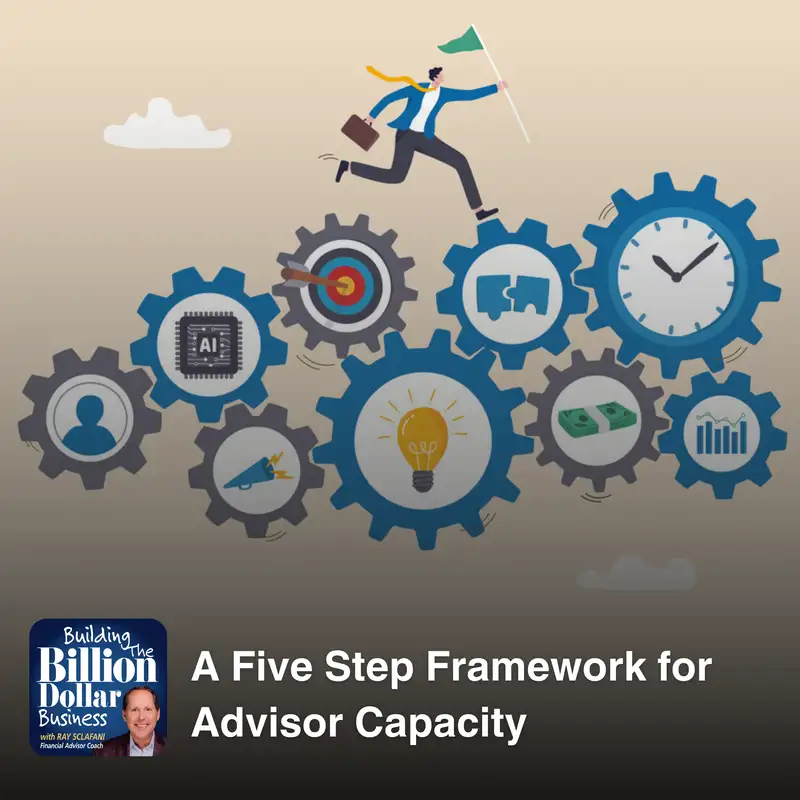
A Five Step Framework for Advisor Capacity

Your best advisors are stretched thin, and it is tempting to blame the calendar. In this episode, Ray Sclafani makes the case that capacity is a leadership decision, not an operations problem, and shows advisory firm leaders how unresolved choices about clients, roles, and delegation quietly push the heaviest load onto the people the firm can least afford to burn out. Ray connects this to Michael Kitces' 2025 research on associate advisor delegation, which found that smart delegation can meaningfully speed up the return on a new hire while protecting senior advisors from unnecessary client work. He then walks through a five step framework for segmenting clients, defining service models, clarifying roles, measuring capacity objectively, and hiring ahead of the breaking point. Firm leaders will walk away with a concrete way to diagnose where capacity is leaking in their business and a practical plan for protecting their top talent while growing enterprise value. WHAT YOU'LL LEARN IN THIS EPISODE Why overloaded top performers usually signal a leadership gap rather than a staffing shortage. Four questions to diagnose team structure, capacity measurement, proactive hiring, and review cadence. How Michael Kitces' 2025 research on associate advisor delegation ties directly to firm capacity. How to design roles and service models so lower value work moves off the senior advisor's plate. Why a quarterly capacity review is the practical tool for hiring ahead of the breaking point. THE FIVE STEP CAPACITY FRAMEWORK Define your client segments. Define the service model for each segment. Define the roles around the service model. Measure capacity objectively. Hire ahead of the breaking point. REFLECTION QUESTIONS FOR YOUR LEADERSHIP TEAM Where is your firm relying on heroic effort rather than a better structure? Which client segments require distinct service models, roles, and staffing assumptions? What work should your senior advisors stop doing in the next 90 days? What capacity signals would tell you it's time to hire before performance starts to slip? How will you implement a system so that every 90 days you're evaluating the opportunity to infuse AI into your workforce? RESOURCES MENTIONED Kitces Report: What Actually Contributes To Advisor Wellbeing ClientWise Executive Coaching and Team Development Building the Billion Dollar Business is hosted by Ray Sclafani, founder and CEO of ClientWise, the financial services industry's leading executive coaching and team development firm for elite advisors and wealth management teams. Find Ray and the ClientWise Team on the ClientWise website or LinkedIn | Twitter | Instagram | Facebook | YouTube
#116

Career Paths Are the New Retention Strategy

The next generation of financial advisors and leaders are not asking for a job, they're asking for a future. Ray Sclafani explores why career pathing has evolved from a nice-to-have benefit into the most critical retention lever advisory firms have. Drawing on Deloitte's 2025 research showing only 6% of Gen Z and Millennials prioritize reaching a leadership position, Ray unpacks what ambition actually looks like today: growth, meaning, money, well-being, and a thoughtful pace of development. For advisory firm owners and leaders, the implications are direct. A firm with no clear development path doesn't stand still, it falls behind. This episode provides a five-part framework for building career pathways that work. Ray then shares a practical starting point: a single career conversation in the next 60 to 90 days that changes how your people feel about their future with your firm. The firms that provide honest visibility of a future worth building will retain more top talent, develop better leaders, and build more durable businesses. WHAT YOU'LL LEARN IN THIS EPISODE Why the next generation defines ambition differently and what that means for retention strategy How to define roles with clarity and purpose so every position has a visible pathway The single biggest mistake firms make when building career paths and how to avoid it Why addressing AI's role impact directly is now a core part of career development How to eliminate ambiguity around partnership so people stop guessing what it means THE FIVE-PART CAREER PATHING FRAMEWORK Define the Roles. Establish clear purpose, expectations, and required skills for each position. Map progression pathways for advisors (from client service associate to enterprise leader), operations (specialist to enterprise operator), and leadership (people manager to executive leader). Define the Progression. Specify what it takes to move from one role to the next: technical skills, client relationship management, leadership capabilities, business development expectations, decision rights, and cultural behaviors. Specificity builds trust. Connect to Actual Development. Attach real development objectives to each progression step. Identify specific competencies that need improvement, not vague hopes. The manager's job is connecting today's work to tomorrow's opportunity. Address AI's Impact. Clarify which skills become more valuable (empathy, judgment, planning, decision making, communication, relationship leadership) and commit to training people to use AI responsibly. Don't let people wonder alone. Make Ownership Expectations Clear. Define passages to partnership, distinguish between producing and nonproducing partners, clarify income versus equity partnership, and spell out what business development, client retention, leadership, and enterprise thinking mean for ownership. REFLECTION QUESTIONS FOR YOUR LEADERSHIP TEAM Can every high potential employee at your firm see a future worth working toward? Where are career paths clearly defined, and where are they implied but not yet documented? Which roles will AI reshape first? And how are you preparing your team for that shift? Who needs a development conversation before they start taking calls from another firm? RESOURCES MENTIONED Deloitte 2025 Gen Z and Millennial Survey Schwab 2025 Career Pathing Research CFP Board Career Pathway Resources ClientWise Business Builders Academy™ ClientWise Executive Coaching and Team Development Building the Billion Dollar Business is hosted by Ray Sclafani, founder and CEO of ClientWise, the financial services industry's leading executive coaching and team development firm for elite advisors and wealth management teams. Find Ray and the ClientWise Team on the ClientWise website or LinkedIn | Twitter | Instagram | Facebook | YouTube Building The Billion Dollar Business